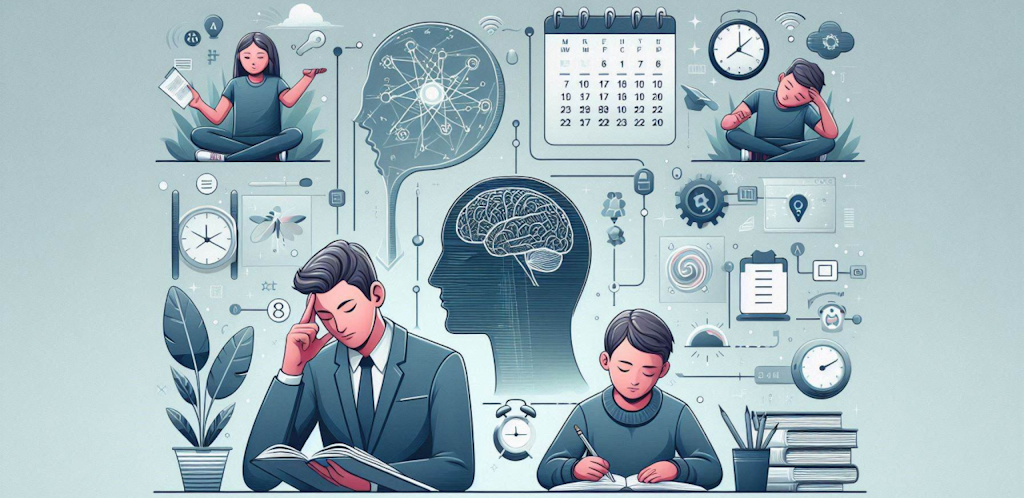
Do you know what’s the best study method? I’ve done some research on the subject and it turns out that I didn’t know, and probably most people don’t either.
Although my research is still incomplete, I think it’s already worthwhile to share my findings. I hope IT professionals in my network will be interested in effective learning, because people in this profession have to study a lot. Besides that this content could be also beneficial to students or parents with school kids.
It shouldn’t be controversial to say that schools don’t teach how to learn (at least not in Poland). Most students, at any level of education, use very inefficient learning techniques. That also applies to adults who prepare for certifications or professional exams.
What are ineffective learning techniques?
- Re-reading materials several times
- Making summaries
- Highlighting text with colorful highlighters
- Cramming
It’s not that these methods don’t work at all. They’re OK for the easy stuff or when familiarity is enough. But they require more effort/time than effective techniques to achieve top results.
Effective learning techniques are proven by numerous studies and experiments. It turns out that studying is quite well researched by cognitive scientists. The best techniques include:
- Feynman Technique
- Active Recall
- Spaced Repetition
- (There’s also a similar method called SQ3R, it combines some parts of the previous ones)
The Feynman Technique – in short, it’s about understanding a topic so well that you can explain it to a kid with your own words. 🚀 One of the possible applications: read a section in a book, then close the book and try to say out loud what you learned. Write it down if needed. Then open the book and compare. Repeat it if the result wasn’t satisfactory.
Spaced Repetition – it’s the opposite of cramming. Each learned bit of knowledge should be re-learned in incremental time intervals. 🚀 E.g., if you learned something new today, repeat it tomorrow, then again after 2 days, then 4, a week, etc. This technique is a foundation for language learning flashcards. But it’s also essential for moving the stuff learned by the Feynman Technique to long-term memory. It also prevents you from learning too often (repeating flashcards too early is a waste of time).
Active Recall – this technique is fundamental for learning long materials. It’s a method of active retrieval of information from the brain (as opposed to the passive re-reading). So, in short, it’s about testing yourself. It works because information is put into long-term memory not during reading, but when you try to recall it. 🚀 Possible application: after finishing a section with the Feynman Technique, convert it into questions (on flashcards). When spaced repetition tells you to revisit the fragment, go back to flashcards in your question deck. Don’t go back to the book/source materials. This way you won’t waste time re-reading the same thing again and again. ⚠️ Warning: flashcards are only effective when you understand the underlying concepts. Don’t use them for rote memorization.
An effective learning routine combines all methods described above. The Feynman Technique should be used to put information into the brain. Active Recall to test yourself and move the information into long-term memory. And Spaced repetition tells you when you should apply Active Recall.
Effective learning is not rocket science, but also not a skill people are born with. It’s something you have to learn. While this text only scratches the surface, I hope someone will find even such a gist useful.
Tools and other helpers:
- Flashcard software: Anki + Anki Web + AnkiDroid. (But Kids should use a poster board instead!)
- Pomodoro timer
- Mindmaps (create it bit by bit after finishing with the Feynman Technique; don’t waste time on “making them beautiful”)
- Interleaving
- Silence (no music)
Some resources:
- Book: Outsmart Your Studies: How To Study & Learn Effectively
- Video: How to Study for Exams - An Evidence-Based Masterclass https://youtu.be/Lt54CX9DmS4
- There are tons of resources on studying, but unfortunately most of them just repeat old methods or only touch on stuff around learning, motivation, etc
Andrzej Nowik, v1/2025.05.22
.